
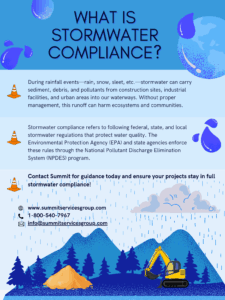
What is Stormwater Compliance?
During a rainfall event (i.e. rain, snow, sleet, etc.), stormwater can flow across construction sites, industrial facilities, and urban areas, picking up sediment, debris, and various pollutants along the way.
Without effective management, the stormwater can carry these pollutants off site and negatively impact waterways, ecosystems, and surrounding communities. Stormwater compliance provides the framework to prevent these impacts.
Understanding Stormwater Compliance
Stormwater compliance refers to following federal, state, and local stormwater regulations that protect water quality. The Environmental Protection Agency (EPA) and state agencies enforce these rules through the National Pollutant Discharge Elimination System (NPDES) program.
Every state has a designated agency that administers NPDES authority and enforces stormwater compliance. In the State of Colorado, the Colorado Department of Public Health and Environment (CDPHE) administers NPDES authority through the state’s Colorado Discharge Permit System (CDPS). This program issues permits and enforces requirements for construction sites, industrial facilities, and municipal separate storm sewer systems (MS4s).
So where does Summit come in? Summit Services Group is not a regulatory agency and does not enforce permit requirements. Rather, our role in stormwater compliance is to help clients understand and meet the NPDES requirements—through permit assistance, plan development, site inspections, and ongoing compliance support—so that projects stay in good standing with CDPHE and EPA regulations.
Why Stormwater Regulations Matter
Stormwater runoff is one of the leading causes of water pollution in the United States. By complying with NPDES compliance requirements, businesses not only avoid costly fines and delays, but also demonstrate environmental responsibility.
Noncompliance can result in:
- Financial penalties
- Project delays or shutdowns
- Damage to reputation and community trust
How to Stay Compliant
Stormwater regulations can be complex, and requirements vary depending on your location and project type. In Colorado, construction activities that disturb one acre or more of land are generally required to obtain a CDPHE stormwater discharge permit. Smaller sites that are not a part of a larger common development may also need a permit (state and/or local) depending on the project and location.
To stay compliant in Colorado, regulated sites are generally required to:
- Obtain required stormwater permits (state and local)
- Develop and maintain a Stormwater Management Plan (SWMP)
- Implement erosion and sediment control best management practices (BMPs)
- Conduct routine site inspections and maintain compliance records
- Train employees on stormwater pollution prevention measures
- Submit required reports to CDPHE and comply with CDPS permit conditions
Having an experienced partner in stormwater compliance makes a big difference. Summit Services Group helps clients navigate every stage of compliance, from permit applications to on-site inspections, reporting, and 24-hour notice state inspections.
Contact Summit for guidance today and ensure your projects stay in full stormwater compliance.